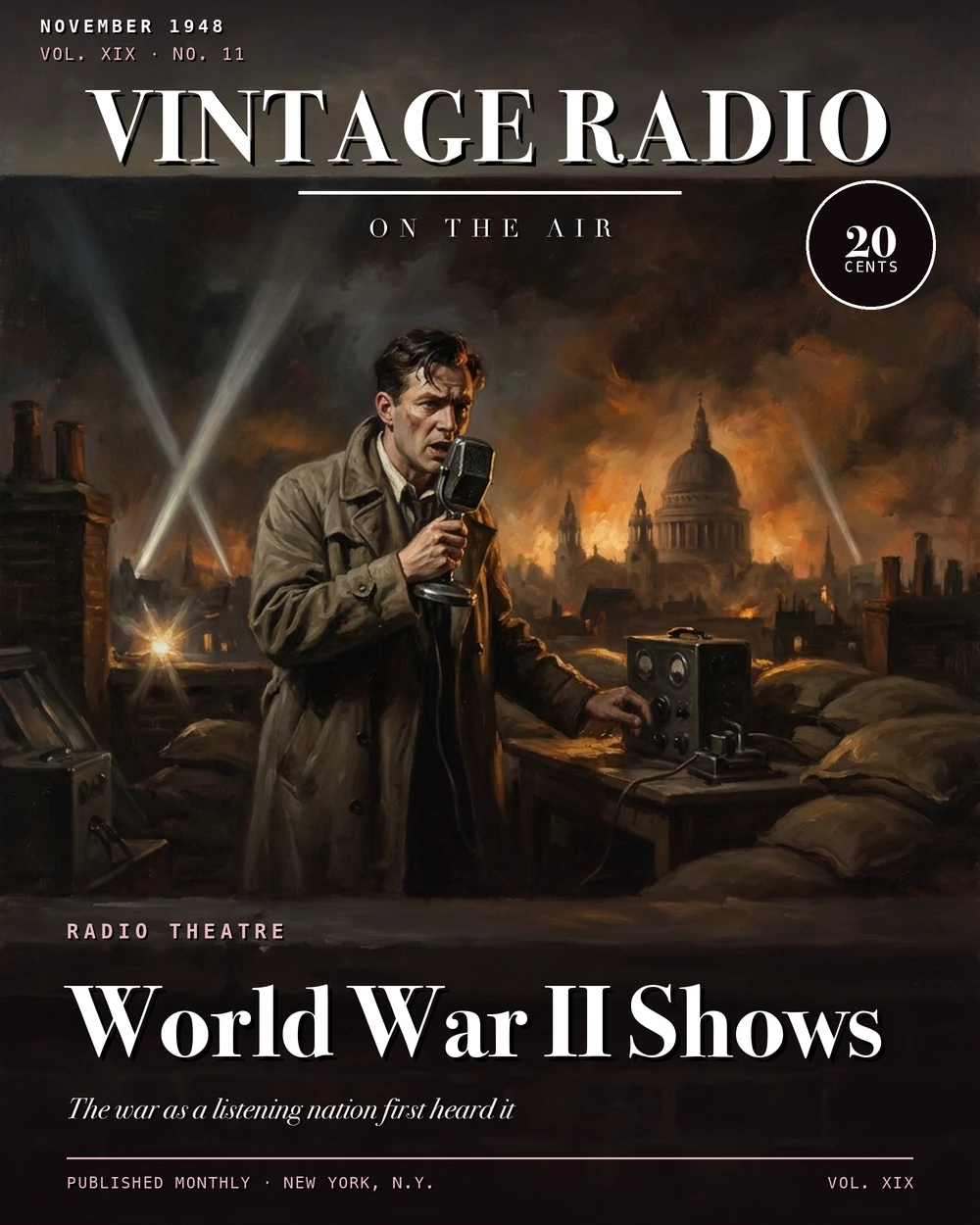
World War II Shows
When Radio Became the News
Before television, before the internet, before the twenty-four-hour news cycle, there was the radio set in the living room — and during World War II, that set became the most important piece of furniture in the house. By 1939, surveys found that a majority of American housewives considered radio more indispensable than the refrigerator or the clothes iron. That says something about what the medium had become. When the war came, radio didn't just report on it; radio was the war, for millions of people who had no other way to know what was happening an ocean away.
This catalog of 400 episodes spans the full arc of the conflict, from May 1937 — when war was still a gathering storm over Europe — through October 1946, when the world was learning to be at peace again. The episodes range from on-the-ground reports at Belsen and Torgau to home-front bond drives and special network broadcasts, capturing the texture of a war that was fought as much over the airwaves as on any battlefield. What you hear in these recordings is not a polished retrospective. It is the news as it sounded when no one knew how it would end.
The Correspondents Who Made It Real
The heart of wartime radio journalism was the foreign correspondent, and no one shaped that role more decisively than Edward R. Murrow. CBS sent Murrow to London in 1937 to run their European operations, and he built around him a team that came to be called the Murrow Boys — Howard K. Smith, Charles Collingwood, Larry LeSueur, Eric Sevareid, and William L. Shirer, all sending shortwave broadcasts from across a continent sliding toward catastrophe. Murrow's opening line, "This…is London," became one of the most recognized phrases in the history of broadcasting. He closed each broadcast with "Good night, and good luck." In April 1945, he personally covered the liberation of Buchenwald, and on VE Day he broadcast live from Piccadilly Circus amid the celebrating crowds.
The BBC sent its own correspondents into danger with equal commitment. Wynford Vaughan-Thomas, a Welsh broadcaster who had joined the BBC in the mid-1930s, reported the Blitz from London and became a full war correspondent in 1942. On the night of September 3, 1943, he broadcast live from aboard an RAF Lancaster bomber over Berlin — a piece of radio that still stops you cold when you hear it. He also reported from the Battle of Anzio and from Bergen-Belsen. Frank Gillard, another BBC correspondent, covered North Africa, Sicily, Italy, and Normandy, and followed the Allied advance all the way to Torgau on the Elbe River, where American and Soviet forces met in April 1945. Both names appear directly in the episode titles of this catalog — "In Belsen," "Gillard At Torgau" — connecting the recordings to specific, documented moments in the war's final year.
Gabriel Heatter and the Voice of the Home Front
Not every broadcast came from a bombed-out city or a military encampment. On the American home front, radio commentary played its own essential role, and few voices were more listened-to than Gabriel Heatter's. Heatter was a commentator on the Mutual Broadcasting System who had first gained national prominence in 1933 covering the Lindbergh kidnapping trial. During the war he became known for something very specific: his ability to find a reason for hope when the news was genuinely grim.
His signature phrase — "There's good news tonight" — was coined during the difficult early months of the Pacific War, after the U.S. Navy sank a Japanese destroyer. Heatter built his broadcasts around human-interest narratives alongside the harder news, working to debunk propaganda and rumor while keeping his audience's spirits from collapsing entirely. He was a peer and competitor of Walter Winchell, and he remained a fixture on Mutual until 1961. The episode simply titled "Gabriel Heatter" in this catalog represents the kind of home-front commentary that kept American households oriented through years of uncertainty.
The March of Time and the Shape of News Radio
One of the most influential programs of the wartime era began well before Pearl Harbor. The March of Time originated on CBS Radio on March 6, 1931, developed by radio executive Fred Smith and Roy Larsen of Time magazine as a way to dramatize news events that couldn't be reported live. Produced by the advertising agency Batten, Barton, Durstine & Osborn, the program was narrated for most of its run by Westbrook Van Voorhis, whose closing declaration — "Time — marches on!" — became a signature of the era.
Between 1935 and 1942, roughly 24 percent of The March of Time's episodes dealt with war or the threat of war. From December 1941 until the end of the conflict, nearly every episode did. In 1942, the program shifted away from dramatized reenactments toward straightforward news reports supplied by Time correspondents in Cairo, Australia, New Delhi, Moscow, and elsewhere. The shift mattered: the earlier approach had been so convincing that many listeners took the dramatized portrayals for authentic, unfiltered news — a fact scholars have long studied for its propagandistic implications. That blurry line between dramatized news and actual reporting was one of the defining tensions of wartime radio journalism, and The March of Time sat right at the center of it. The program ran until 1945.
The Networks Go to War
When the United States entered the war on December 7, 1941, all the major networks had already been building toward this moment. CBS's famous World News Roundup — which still broadcasts today — traces its origins to a special "News Roundup" produced on March 13, 1938, in reaction to the Nazi annexation of Austria. NBC had officially launched its International Division on July 26, 1937, broadcasting in English, French, German, and Italian to Europe and in Spanish and Portuguese to Latin America.
After Pearl Harbor, NBC's International Division expanded to broadcast in over a dozen languages. Eventually, both NBC's shortwave service and CBS's equivalent were folded into the Voice of America, established on February 1, 1942. Radio dramas produced specifically for the home front included NBC's Eyes Aloft (1942–43), about the Civilian Aircraft Warning Service; NBC's Battle Stations (1943), about the Navy; and ABC's The Fighting AAF (1945), produced by the Air Force. These weren't entertainment programs that happened to mention the war — they were instruments of wartime communication, produced in coordination with the military branches they depicted.
The National Archives holds extensive collections of WWII-era radio broadcasts, including the Milo Ryan Phonoarchive, recovered from acetate discs at Seattle station KIRO, which catalogs 4,221 titles of wartime newscasts, speeches, and related recordings. The 400 episodes in this collection represent a cross-section of that era — network specials, correspondent dispatches, bond drives, and commentary — drawn from the period when radio news was operating at the highest pitch of its influence.
What Came After
The war ended, but the journalism it had called into being didn't simply disappear. In December 1950, Edward R. Murrow and producer Fred W. Friendly launched Hear It Now on CBS — a magazine-format news program that used actual sound recordings of current events rather than dramatizations or summaries. The 1950 Peabody Awards described it as "a brilliant application of tape-recording to the purpose of the news summary." It ran until June 1951 and was replaced by the television version, See It Now, in November of that year.
You Are There — originally called CBS Is There and created by Goodman Ace — first aired on July 7, 1947, after the war had ended. It dramatized historical events from across time, using the in-the-moment reporting style that CBS war correspondents had developed during the conflict. Actual correspondents including John Charles Daly, Don Hollenbeck, and Richard C. Hottelet appeared as hosts. The show ran until March 19, 1950. Its connection to the war wasn't its subject matter but its method — the on-the-scene, you-are-here approach to storytelling that Murrow and his colleagues had pioneered from London and Berlin and the beaches of Normandy.
The catalog's latest known broadcast date of October 16, 1946 sits right in the middle of this transition period — the war over, the world still sorting out what had happened, and radio still the primary vehicle through which most Americans understood it. These recordings don't just document the war; they document what journalism sounded like at the moment it found its modern form.